


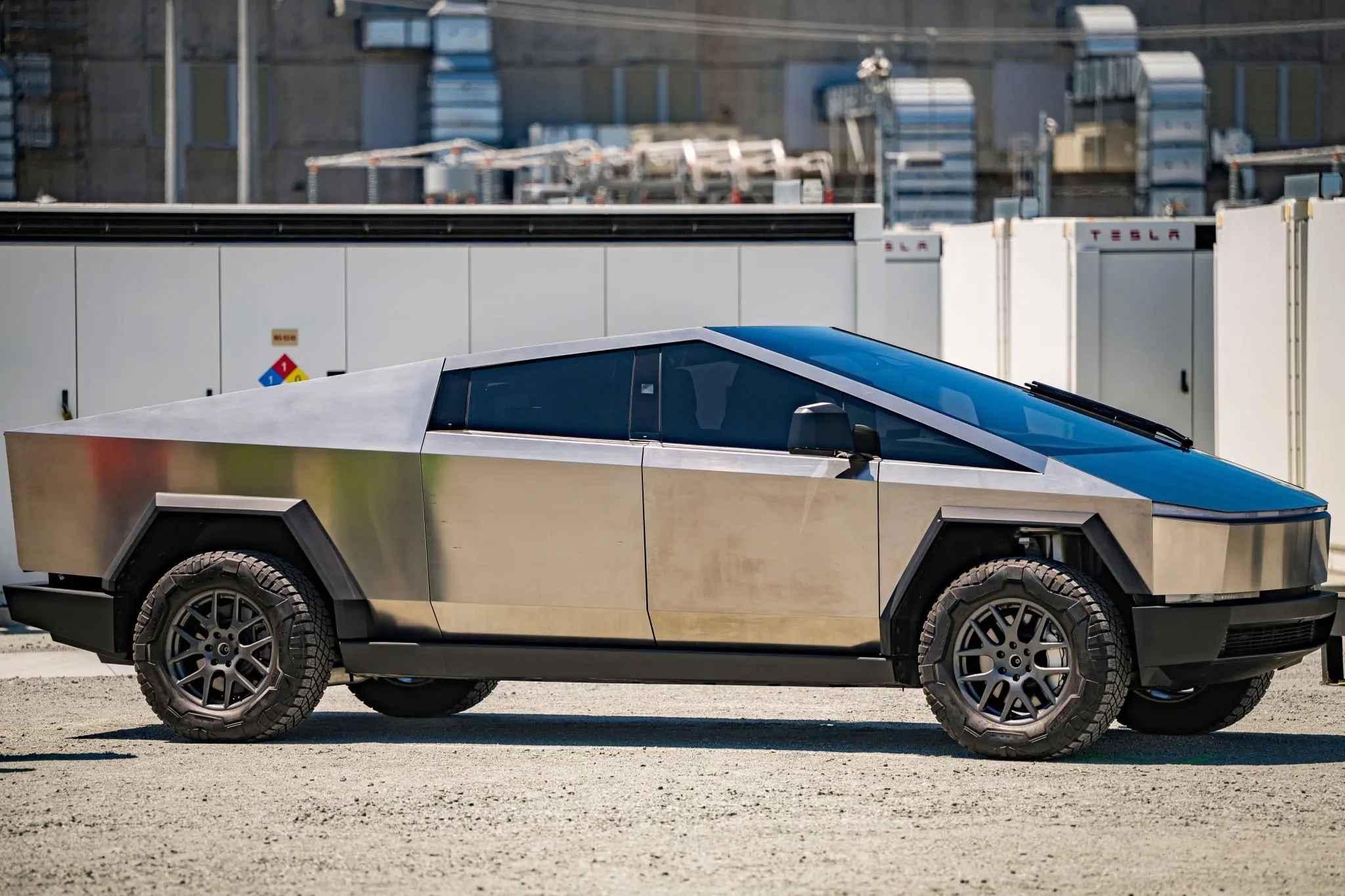
A Rubberized Cybertruck Is Navigating European Pedestrian Safety Regulations

Tesla’s problematic electric pickup cannot be sold in Europe, but a slightly altered version has managed to obtain a license. A coalition of European transportation associations asserts that this journey might lead to calamity.
THE EUROPEAN NEW Car Assessment Program (Euro NCAP) has not yet evaluated, examined, weighed, or crashed a Tesla Cybertruck—or assessed if pedestrians could endure a collision with this angular vehicle—but Elon Musk’s electric pickup might still receive low scores on the assessments regardless.
“According to Matthew Avery, director of strategic development at Euro NCAP, the car’s visual features suggest multiple elements that could pose a danger to pedestrians.” “You cannot fail Euro NCAP,” he remarks, “but you can receive a poor score.”
While cars aren’t legally required to undergo a Euro NCAP test, a poor score represents more than just a mark of shame; it discourages buyers who are often hesitant to purchase vehicles that compromise on safety.
The Euro NCAP was launched in 1997. It offered impartial guidance on which cars might be lethal, versus which should crumple effectively to safeguard the passengers. Pedestrian safety, or the absence of it, was assessed from the very beginning.
Until lately, there has been a disappointing neglect in the US regarding comparable pedestrian safety from vehicles. Earlier this month, the National Highway Traffic Safety Administration (NHTSA) introduced the initial regulation aimed at reducing the risk of head injuries to pedestrians during a crash.
Europe’s stricter rules lead to safer vehicles, benefiting both occupants and pedestrians. Created to evaluate a car’s safety during a collision, Euro NCAP quickly dismantled car manufacturers’ safety assertions through thorough independent testing, concrete data, and a straightforward five-star rating system.
Selling a car in the EU is difficult if it has fewer than a four- or five-star rating. However, vehicles that receive a zero score can still be sold and are entirely legal to purchase. For instance, the budget Dacia Spring EV we just evaluated is priced at a compelling $19,000 if marketed in the US, but this affordable pricing affects the car’s safety, leading to a disappointing 1-star NCAP rating.
Nonetheless, it requires a specific type of buyer to purchase a car aware of its low safety star rating for passengers and possible Mad-Max-style danger to individuals outside the vehicle. What type of consumer would purchase a Cybertruck?
At least one Cybertruck has been spotted navigating through cities in the Czech Republic, which is part of the EU, as a coalition of transport NGOs cautions that Musk’s controversial EV, known for its problematic development, is excessively bulky and sharp for European roads.
“According to an open letter from NGOs addressed to the European Commission and national vehicle authorities in Europe, the approval and registration of Cybertrucks in the EU present illegal dangers to all other road users.”
“The limited quantity of Cybertrucks registered to date in the EU must be de-registered, with the respective Member States verifying their removal from public streets,” the letter states, endorsed by leaders of, among others, the European Transport Safety Council, the International Federation of Pedestrians, and the European Cyclists’ Federation.
“Extremely large pickup trucks [are] increasingly being imported and posing risks to our roads,” cautioned James Nix from the nonprofit Transport & Environment, one of the groups that endorsed the open letter, referencing the US consumer advocacy nonprofit Center for Auto Safety’s assessment that equates the EV’s potential to injure pedestrians to “a guided missile.”
EU automotive regulations bar pointed edges on vehicles. The Cybertruck brought into the Czech Republic is equipped with alarmingly thin rubber pads to mitigate these edges.

In relation to this modification, the open letter mentions that: “Throughout the registration process, Czech officials mandated the addition of ultra-narrow rubber slats to [the] Cybertruck authorized in early July. This retrofitting procedure would initially violate EU regulations against sharp edges.
In a recent YouTube review of the Cybertruck, ex-Top Gear and Grand Tour host James May candidly criticized the vehicle’s sharp angles, gesturing toward the front corner of his test electric truck, and stating: “I mean, look at that. I wouldn’t want to be struck by it. I wouldn’t want to be struck by any vehicle, but particularly not that one, since, you know, it’s a corner. Typically, cars don’t have corners on their fronts, but in that case, they do.
The EU motor regulations also mandate speed limiters on vehicles that have a full weight exceeding 3.5 metric tons. Tesla’s manual states that the steel vehicle has a total weight of 4 metric tons.
“Because it’s not intended for Europe … we won’t evaluate [the Cybertruck],” says Avery from Euro NCAP. He further notes that another obstacle is the absence of “type approval” for the Cybertruck.
EU type approval refers to the validation that production samples of a design conform to the performance standards established by the automotive directives of the European Commission.
Imported vehicles can be registered via an “individual vehicle approval,” which entails less examination than a regular type approval. Approval authorities in Member States, tasked with inspecting vehicles prior to sale, have flexibility to diverge from EU regulations in specific instances if they set different requirements.
In its open letter, the group of NGOs mentioned that the owner-importer of the Cybertruck tried to categorize this import as a light-duty vehicle according to EU regulations.
The letter requests that the Czech transport ministry identify a legal foundation permitting the vehicle’s maximum weight, as stated by the manufacturer and shown on the Vehicle Identification Number (VIN) plate, to be overlooked in favor of a figure nearly half a ton lower, conveniently aligning with the EU weight restriction for light-duty vehicles.
“Avery states that if we were to witness large-scale private imports or any way to bypass type approval, we might think about a singular [test of a Cybertruck].”
“To be considered ‘pedestrian-friendly,’ a car must possess energy-absorbing features and a harmonious front design, which should be mostly flat without any protruding elements such as bumper steps,” he states.
“We evaluate a vehicle using head and leg forms that mimic human anatomy.” We target these at critical spots on the vehicle that we understand could cause harm—such as directing a lower leg at the bumper zone.
“It appears that the step [on a Cybertruck] could generate bending forces that may be harmful.” We possess an upper leg that is shot at the edge of the bonnet. Once more, you would desire energy-absorbing structures that do not have any protrusions. I can notice the pronounced angle and the overall rigidity of the [Cybertruck’s] stainless steel affecting this.
The Cybertruck’s hood must also be flexible, and there should be no protrusions to achieve a high NCAP pedestrian safety rating.
Avery predicts that “the sizable wiper and boss of the [Cybertruck] could pose a risk.”
As stated by the transport NGOs, the updated Cybertruck was registered in the Czech Republic in July. The registration was done using the Individual Vehicle Approval system of the Czech Republic. The Czech transport ministry stated that all vehicles classified under the N1 category, where the truck was registered, have weight ratios determined by formulas outlined in the EU regulation from 2018. However, the vehicle data it supplied indicates that the Cybertruck fails to meet the formulas when transporting four passengers.
To drive it legally in Europe, a customer of the Cybertruck would require a category C license. This is a truck license intended for operating vehicles with a gross vehicle weight rating (GVWR) exceeding 3.5 metric tons, or 7,716 lbs.
Norton Slovak, cofounder of Cybertruck.cz, which has the imported Tesla truck, informed The Guardian that he knew about the difference in vehicle weight and the regulations, but stated that the “calculations might not entirely represent how Czech authorities apply or interpret these regulations.”
The Czech transport ministry viewed the discrepancy as non-problematic since the registration was “specific approval of a vehicle only within the territory of the Czech Republic” rather than a type approval for the entire EU.
Nonetheless, the truck, which the owners lease for advertising purposes, has already been taken to other EU countries such as Slovakia, where on an Instagram post, you can find the company trying out “Wade Mode” on the Cybertruck in a lake close to Bratislava. Plans go awry, and the all-terrain EV becomes immobilized in the water, necessitating assistance from bystanders to push it free and position boards beneath the wheels.
Tesla, Norton Slovak, and the Czech Republic’s Ministry of Transport were all reached out to for this article, but none replied. In their public letter, the transport NGOs contend that should the European Commission not intervene, the entry of this one, rubber-edged Cybertruck could result in the “large-scale import of Cybertrucks into Europe,” which they claim would pose a risk to pedestrians, cyclists, and drivers of vehicles that aren’t similarly fortified. Euro NCAP appears to concur with that finding.
